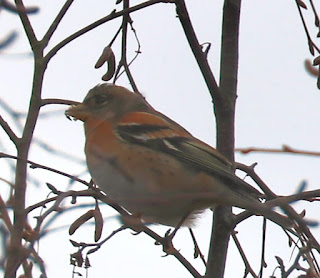
Overcast, 5°, light NNW. A Little Egret seen today on the way out to Lollingdon and appeared to drop down near Amwell Spring. The hill hosted around 100 Fieldfare and a flock of c50 Meadow Pipit for a time before moving off over the top. Several Reed Bunting and Yellowhammer around the hill and a single Corn Bunting . A small flock of c20 Pied Wagtail feeding out with the Sheep. A few more Fieldfare and Redwing scattered around the Lollingdon area, a Goldcrest , Grey Heron , Kestrel , a couple of Jay , 2 Bullfinch and several Starling amongst other species. A Brambling in a private garden. Per Alan Dawson. 2 Blackcap in TW’s garden and 2 Chiffchaff at CSW. The flock of c60 Golden Plover still around Cholsey Hill. Brambling (courtesy Alan Dawson) from Cholsey Wildlife https://cholseywildlife.blogspot.com/2019/01/2019-off-to-reasonable-start.html
The squirrel has spent a bit of time in the Yew View tawny box this week, which has given me an idea of what my footage might be like during the daytime. I am really pleased with this camera and keep imagining the tawny and owlets I might get in the new year. The squirrels are not showing signs of nesting… just a place to sleep on a cold winter’s day and this individual left at dusk before the tawnies returned. What was really interesting was this footage of the squirrel opening a walnut. Anyone who has tried to open a walnut with nut crackers will know how hard they are! This individual seems to turn the walnut around and around, biting along the seam, weakening it until it could get its teeth and claws inside this seam to break it open… fascinating! from www.wildlifekate.co.uk https://wildlifekate.wordpress.com/2018/12/16/how-does-a-squirrel-open-a-walnut/
I am getting very excited about the Tawny Box project at Yew View! If you follow my blog, then you’ll know that this pair have nested for the last 2 years in this location and this year I designed a new nest box and built it with the help of friend, Dave. I have built this box to house two internal cameras, placed perpendicular to each other. I started with the camera I used last year; a Vivotek that I have used a lot in these boxes. It is a great little camera, but it has it has its limitations. My initial set up had the Vivotek in one position and a little Hikvision mini dome camera in the second position. I was so pleased with the image from this cam that, last week, I decided to swap the Vivotek out for another Hikvision. I am really pleased I did as I am now really happy with all three camera angles and footage in this box. I become quite obsessed with getting it just right as, once they settle in there, I can’t fiddle with them any more. This week’s footage is the best I have...




Comments
Post a Comment